

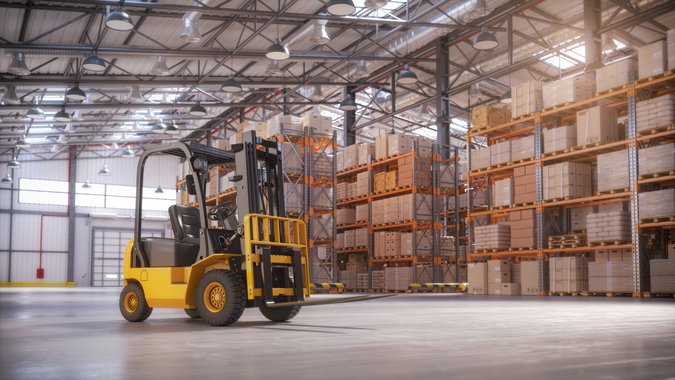
There is no published price for distributor or wholesaler insurance in South Dakota, and any number offered before an underwriter has seen your operation is a guess. An insurance carrier builds the cost from what you own and what could happen to it — and in South Dakota, the worst thing that can happen to it often leaves the building looking perfectly fine.
The loss with nothing to photograph
South Dakota’s owned-inventory economy leans hard on the cold chain. Food, grocery, and protein wholesalers here hold refrigerated and frozen stock whose entire value depends on temperature holding, through a hard-winter, hot-summer climate that gives the equipment no easy season.
So the defining South Dakota loss is not a fire and it is not a storm. It is a compressor failure, or a power loss, and it destroys the value of the goods without leaving a mark on the structure. There is nothing to photograph. The roof is intact, the walls are intact, the racking is intact, and the inventory — which was on your balance sheet, not anyone else’s — is worthless.
That is an inventory loss, and it is the reason commercial property is a necessary but incomplete answer for a distributor here. Property does a bounded job: the building, the racking, and the owned stock while it sits in a scheduled location, plus the income lost when that location goes down. Whether it responds to a temperature excursion with no physical damage attached is a wording question, not a limit question — and it is worth reading before a summer rather than after one.
<text x="350" y="32" text-anchor="middle" font-family="Inter, sans-serif" font-size="15" font-weight="600" fill="#0F4C5C">The same event, seen two ways</text>

<rect x="48" y="60" width="258" height="132" rx="8" fill="#ffffff" stroke="#C3DEDE"/>
<text x="177" y="90" text-anchor="middle" font-family="Inter, sans-serif" font-size="13" font-weight="600" fill="#0F4C5C">the building</text>
<text x="177" y="118" text-anchor="middle" font-family="Inter, sans-serif" font-size="12" fill="#3F5B64">roof intact</text>
<text x="177" y="140" text-anchor="middle" font-family="Inter, sans-serif" font-size="12" fill="#3F5B64">walls intact</text>
<text x="177" y="162" text-anchor="middle" font-family="Inter, sans-serif" font-size="12" fill="#3F5B64">racking intact</text>
<text x="177" y="184" text-anchor="middle" font-family="Inter, sans-serif" font-size="12" font-weight="600" fill="#0F4C5C">nothing to photograph</text>

<rect x="394" y="60" width="258" height="132" rx="8" fill="#E2F4F3" stroke="#0F4C5C"/>
<text x="523" y="90" text-anchor="middle" font-family="Inter, sans-serif" font-size="13" font-weight="600" fill="#0F4C5C">the inventory</text>
<text x="523" y="118" text-anchor="middle" font-family="Inter, sans-serif" font-size="12" fill="#3F5B64">temperature not held</text>
<text x="523" y="140" text-anchor="middle" font-family="Inter, sans-serif" font-size="12" fill="#3F5B64">a total loss</text>
<text x="523" y="162" text-anchor="middle" font-family="Inter, sans-serif" font-size="12" fill="#3F5B64">your balance sheet</text>
<text x="523" y="184" text-anchor="middle" font-family="Inter, sans-serif" font-size="12" font-weight="600" fill="#0F4C5C">everything to lose</text>

<rect x="40" y="228" width="620" height="56" rx="9" fill="#C8935A" stroke="#0F4C5C"/>
<text x="350" y="254" text-anchor="middle" font-family="Inter, sans-serif" font-size="14" font-weight="600" fill="#1A1A1A">The worst South Dakota loss leaves the roof on.</text>
<text x="350" y="274" text-anchor="middle" font-family="Inter, sans-serif" font-size="12" font-weight="600" fill="#1A1A1A">Whether the program answers for it is a wording question.</text>

<text x="350" y="312" text-anchor="middle" font-family="Inter, sans-serif" font-size="11" fill="#3F5B64">Monitoring, backup power, and a maintenance record are visible to an underwriter.</text>No port, no zone — and a form that still follows the goods
Be honest about the geography, because the honest version is more useful than a flattering one. South Dakota has no seaport, no border-crossing gateway of consequence, and essentially no bonded warehousing. The state’s zone presence at Sioux Falls has historically been a single warehouse facility rather than a sprawling campus. An importer operating here is far more likely to clear goods at a coastal or Midwestern gateway and truck them in duty-paid than to hold them in a duty-deferred posture in South Dakota. Importing, plainly, is uncommon.
None of which removes the transit exposure. It relocates it.
Your owned stock is on a trailer between a supplier and your dock, and again between your dock and a customer several hundred miles away across a state that moves goods on rubber and moves them regionally. The stock throughput form is a marine-family form, and the name misleads people here — the family does not require an ocean. It follows goods across land transit and rail just as readily, and that is precisely the span a four-walls property policy leaves open. For a landlocked distributor, that span is most of the journey.
And for the minority who do import: the moment you take title, you become the first U.S. seller of goods you never made, and you inherit the products-liability-chain exposure that comes with the role, whatever you did or did not do to the merchandise. Which raises the only question that decides where your coverage has to begin: when does the risk of loss actually pass to you?
Peak, and the seasons that create it
The number that sizes a stock throughput limit is not the number owners give when asked. They give an annual average. The underwriter is asking for the maximum value of owned product concentrated in one place on one day, because a loss does not wait for a convenient month.
South Dakota has two very different books that create that peak. Agricultural input, seed, and equipment distributors carry seasonal, hazard-classed, high-value inventory that peaks sharply in the spring, and then does not. Medical and health-system supply distribution, which has grown up alongside the Sioux Falls health systems, carries a steadier but high-value book that concentrates in one metro. Both of them make the accumulation question real, and neither is described by an average.
The product, and the chain you sit in
One consequence of a protein-and-food book that owners here rarely think through: what you sell is consumable. You sit in the chain of distribution, and a products-liability claim over something that causes injury can follow that chain to a seller — not only to the packer or processor who made it. You did not raise it, process it, or package it. You bought it and you sold it, and that is enough to be named. Anything with an ingestion profile carries a different severity picture than a hard good, and general liability answers it through what the standard form calls the products-completed-operations hazard.
The same logic reaches the state’s other two books along different lines: hazard-classed chemistry for the agricultural-input distributor, and product bound for a clinical setting for the medical and health-system supply distributor. Three books, three different products conversations, one submission — and sizing that limit against what you actually move is most of the real work.
Hail on a wide, flat target
The perils that shape a South Dakota placement are hail and snow. The eastern half of the state sits in an active large-hail corridor, and a distribution roof is a wide, flat target measured in acres, with mechanical units and membrane seams exposed to it; the western half trades some hail for wind. Snow accumulation and drifting against parapets and roof steps put real load on a low-slope roof through a long winter, and hard, sustained freeze threatens sprinkler systems, unheated bays, and any building holding temperature-sensitive stock when heat is lost — which is where this guide started. Tornado exposure is real in the east during the convective season but is not the state’s signature peril. Flood risk is localized along the Missouri, the Big Sioux, and the James rather than statewide, and it is its own placement.
The tier where the tax attaches
If beverages are your book, South Dakota is a license state — the middle tier is private, and the Department of Revenue issues the wholesaler license and collects the tax. The tier walls are the ordinary ones: a licensed wholesaler may buy or receive alcoholic beverages only from licensed manufacturers or wholesalers, and may sell only to a manufacturer, another wholesaler, or a retail licensee.
The wrinkle worth knowing is where the money attaches. Wholesalers pay the tax on the alcohol they receive from suppliers, so the middle tier is exactly where the state’s revenue interest sits — which means the compliance load lands on the same building that holds the inventory, and it is a real operating cost sitting alongside the premium. The insurance consequence is direct: the stock in that warehouse is genuinely yours at every step, which is why it is a stock-throughput exposure rather than somebody else’s goods in your care.
Prescription-drug wholesaling is squarely licensed by the Board of Pharmacy, and food distributors here lean correspondingly harder on federal food-facility registration and on customer audit requirements than they would in a state with a standalone food-warehouse permit. In each case, the state is regulating you on the goods you own.
The fleet, the crew, and one border myth
Commercial auto prices unit count, radius, what is hauled, and above all who drives — and a South Dakota fleet runs long, thin, weather-exposed routes out along I-29 and I-90 to a trade area far larger than the population would suggest. A note on the language this trade cannot avoid: your insurance carrier is the company that writes your policy, an entirely different thing from a motor carrier or a freight carrier hauling goods for hire.
On workers compensation, one correction: despite sharing a border and a climate with North Dakota, South Dakota is not a monopolistic state. Comp is placed with competing insurers here in the ordinary way, in an open private market. A distributor carries two injury exposures rather than one — the warehouse crew on powered industrial trucks and the pick line, and the route drivers loading and unloading — and in the protein and food buildings, cold-stress and slip exposure on freezer floors add a layer a dry building does not have.
The short, true version
South Dakota is a modest, regional distribution economy, and the guide to it should be a short one rather than a padded one. Your stock, the temperature it depends on, the spring it peaks in, what the product becomes once somebody consumes it, the roof over the rest, the road it spends most of its life on, and the drivers who put it there. That is the list. There is nothing else on it, and a guide that pretended otherwise would be selling you length instead of an answer.
If you want the coverage mechanics rather than the cost drivers, stock throughput is the line this guide orbits, the wholesaling businesses pillar covers how these programs are assembled, and the South Dakota distributor and wholesaler insurance page goes deeper. If the goods in your building belong to your customers rather than to you, this is the wrong guide — read the warehouse cost guide instead, or ask us for a quote.