

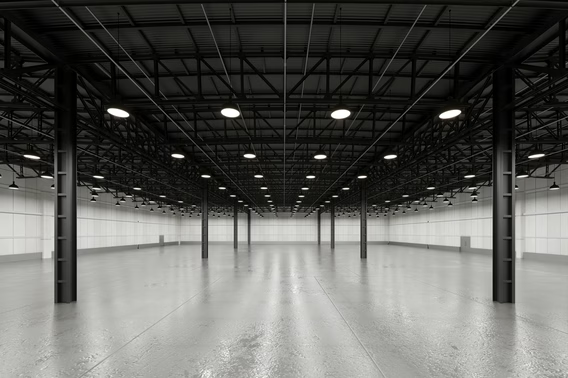
The worst warehouse loss in Mississippi frequently happens after the weather is over.
The storm makes landfall, the wind does what it does, and then it moves on. The building is standing. The roof held. And in the days that follow, while the grid is down and the repair crews are somewhere else, every refrigerated and frozen room in the parish goes quietly warm — and a customer’s poultry, a customer’s seafood, a customer’s food inventory becomes worthless without a single mark on the structure around it.
That is the second loss, and understanding it is most of what a Mississippi warehouse owner needs to understand about what this insurance costs. Because the second loss is not a property claim. It is a claim on somebody else’s goods, and it is warehouse legal liability that has to answer for it.
Cold-chain bailment fails differently
Dry storage fails by fire, water, and impact. Cold storage fails by time and temperature, and the two are not underwritten alike.
The building never burns. The racking is untouched. The refrigeration unit stops, or the power that feeds it stops, and a consignment that was perfectly good at midnight is a total loss by morning. In a state whose poultry, seafood, and food-processing base puts an enormous share of stored value on cold floors, that is not an exotic scenario. It is the scenario.
So an underwriter looking at a Mississippi cold house is not primarily interested in the sprinkler design. They are interested in whether the temperature can drift without anyone noticing: redundancy, alarms, remote monitoring, and — the question that separates the well-run building from the lucky one — a written plan for a multi-day outage after a named storm. Those controls are the price.
Whose freight is on your racks, and how much of it
This is the number that sizes your bailee limit, and it is the one operators most reliably understate — because that inventory never appears in their own accounts.
The archetype here is instructive. The Mississippi bailee is most often storing goods that belong to a company headquartered somewhere else. A DeSoto County third-party warehouse holding a national shipper’s inventory inside the Memphis logistics footprint is the classic case: cheap land inside a national air-and-truck hub’s reach, holding freight that serves the country rather than the state. The customer is enormous. The warehouse is not. The goods on the rack can be worth a multiple of everything the operator owns.
Value is therefore the maximum amount of customer-owned freight under your roof on the worst possible day, not on an average Tuesday. Nature is the half that gets missed: a room of frozen protein, a bay of dry consumer goods, and a pallet of pharmaceuticals can be identical square footage and price nothing alike, because they fail in different ways and are stolen at different rates.
The underwriting conversation is never how big is your warehouse. It is: what is in it, whose is it, and what is the most of it that is ever here at once?
The roof, the wind, and the tornado that comes in January
Your own property — structure, racking, material-handling systems, and the business income lost while a site is down — is a real conversation, just not the first one. Commercial property covers what is yours and stays put.
The Gulf coast counties carry named-storm wind and surge, and Mississippi remembers precisely what that does to a port and to the warehouses behind it. But the peril that reaches the whole state is tornado. Mississippi sits in the corridor where long-track tornadoes run, and they arrive in winter as well as spring — which is not true everywhere, and which catches owners who plan for a season rather than for a year.
A large warehouse roof gives wind an enormous surface and a hailstorm an enormous target. And once the membrane is bruised or breached, the water finds the racking, and then it finds the goods.
Flood is a separate placement and a serious one along the Mississippi delta and the river towns, where the flat ground that makes good warehouse sites is flat because the river made it so. It does not ride the property form, and it deserves to be answered early.
What the state actually licenses — and what it leaves to you
Mississippi licenses grain warehouses and no others. Under the state’s grain warehouse law, a warehouse storing grain for the public must be licensed and bonded through the Department of Agriculture and Commerce unless it is federally licensed instead. That program is real and it is agricultural. It is not a general public-warehouse license and cannot be read as one.
Food is where the state does reach inside the building. The Mississippi State Department of Health, through its food protection division, permits food establishments and names warehouses and re-packers among the facilities it regulates — so a food warehouse here is a permitted premises even though a general warehouse across the road is not. Take a grocery or protein account and you acquire a permit you did not previously need.
For everything else — the contract warehouse, the fulfillment operation, the consumer-goods building — there is no state license at all. The operator of an ordinary Mississippi warehouse is regulated on what it stores, if at all, and not on the fact of warehousing itself.
That absence is a cost driver, not a footnote. Your warehouse receipt and the limitation of liability inside your storage agreement are the entire defense when a customer’s cargo is damaged. Whether that customer accepted the clause, negotiated it away, or signed something that quietly assumed you carry more than a bare legal-liability form provides, changes the exposure the policy is being asked to size. An underwriter reads it. In a state with no license, the storage contract is the regulation.
Bonded on the coast: real, and modest
The coastal foreign-trade zone is granted to Mississippi Coast Foreign-Trade Zone, Inc., and it covers secured sites across the three coastal counties — Hancock, Harrison, and Jackson — at airports, ports, and industrial parks rather than at a single terminal. The Port of Gulfport, run by the state port authority, is the deep-water anchor and has rebuilt itself substantially since Katrina, with rail improvements aimed at moving containers north. Inland, the river ports at Vicksburg and Greenville handle barge cargo on the Mississippi.
Bonded storage here is real but modest — this is a coast that serves a corridor rather than a coast that commands one — and the honest description is worth more to you than an inflated one.
But where you do admit duty-deferred goods, the exposure logic is the same as it is anywhere: you take on customs obligations on top of your ordinary duty of care to the owner of the cargo. Two masters, one pallet. An underwriter prices the accumulation of both, not merely the invoice value of what is on the rack.
The crew, on a cold and wet floor
Workers compensation is a private-market line here, administered by the state’s workers’ compensation commission — no state fund, no opt-out — and it scales with your material-handling payroll and the classifications you actually run.
The warehouse claims look like warehouse claims anywhere: a powered industrial truck and a person in the same aisle, a fall from racking, a pallet coming down during putaway, a dock injury when a trailer moves, and the lifting strain that produces the longest absences.
What Mississippi adds is the floor itself. The poultry, seafood, and food-processing base puts a large share of that work on cold-storage floors, where the surfaces are wet, the shifts are cold, and the slip claims accumulate quietly. Frequency, not severity — and frequency is what tells an underwriter how a building actually runs.
The storm passes. The claim arrives later
<text x="350" y="30" text-anchor="middle" font-family="Inter, sans-serif" font-size="15" font-weight="600" fill="#0F4C5C">One storm, two losses — and the expensive one comes second</text>

<path d="M60 88 L640 88" stroke="#0F4C5C" stroke-width="2"/>
<circle cx="170" cy="88" r="6" fill="#0F4C5C"/>
<circle cx="490" cy="88" r="6" fill="#0F4C5C"/>

<text x="170" y="70" text-anchor="middle" font-family="Inter, sans-serif" font-size="13" font-weight="600" fill="#0F4C5C">Landfall</text>
<text x="490" y="70" text-anchor="middle" font-family="Inter, sans-serif" font-size="13" font-weight="600" fill="#0F4C5C">The days after</text>

<rect x="40" y="106" width="260" height="76" rx="9" fill="#ffffff" stroke="#C3DEDE"/>
<text x="170" y="132" text-anchor="middle" font-family="Inter, sans-serif" font-size="13" font-weight="600" fill="#0F4C5C">Wind, surge, hail on the roof</text>
<text x="170" y="152" text-anchor="middle" font-family="Inter, sans-serif" font-size="12" fill="#3F5B64">Your structure, your racking,</text>
<text x="170" y="170" text-anchor="middle" font-family="Inter, sans-serif" font-size="12" fill="#3F5B64">your business income. A property loss.</text>

<rect x="360" y="106" width="300" height="76" rx="9" fill="#ffffff" stroke="#C3DEDE"/>
<text x="510" y="132" text-anchor="middle" font-family="Inter, sans-serif" font-size="13" font-weight="600" fill="#0F4C5C">The grid is down. The cold room warms.</text>
<text x="510" y="152" text-anchor="middle" font-family="Inter, sans-serif" font-size="12" fill="#3F5B64">No fire. No breach. No alarm anybody</text>
<text x="510" y="170" text-anchor="middle" font-family="Inter, sans-serif" font-size="12" fill="#3F5B64">was there to hear.</text>

<path d="M510 184 L510 200 L350 200 L350 216" stroke="#0F4C5C" stroke-width="2" fill="none"/>

<rect x="70" y="218" width="560" height="72" rx="9" fill="#C8935A" stroke="#0F4C5C"/>
<text x="350" y="246" text-anchor="middle" font-family="Inter, sans-serif" font-size="15" font-weight="600" fill="#1A1A1A">The building is standing. The customers’ goods are gone.</text>
<text x="350" y="270" text-anchor="middle" font-family="Inter, sans-serif" font-size="13" font-weight="600" fill="#1A1A1A">That is a bailee claim, and it is the one that gets contested.</text>

<text x="350" y="320" text-anchor="middle" font-family="Inter, sans-serif" font-size="12" font-style="italic" fill="#3F5B64">Which is why backup power gets underwritten before the sprinkler does.</text>The honest summary
Two very different engines fill Mississippi’s warehouses — cheap land under Memphis in the north, and the port and industrial base on the coast — and population is not what drives either of them. Adjacency is.
But the pricing logic is the same in both places. The heaviest thing in your building belongs to a customer. It can be destroyed by a temperature that drifted while the building sat there perfectly intact. And no state license is standing behind the contract you signed about what happens next.
To see how the coverage itself works rather than what it costs, start with warehouse legal liability, or read the full Mississippi warehouse insurance page. Our warehouse businesses practice explains how we approach the class. And if you own the goods you hold — a food or beverage wholesaler, an industrial supply house — none of the above is your program: read the distributor cost guide instead.