

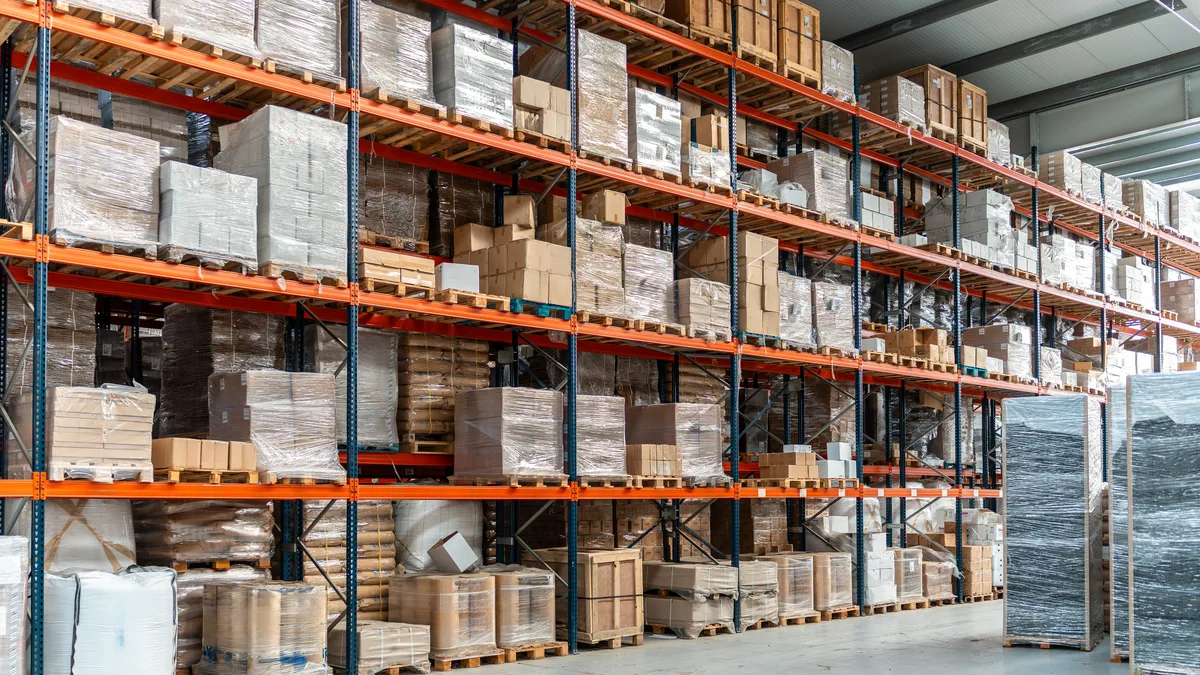
Most warehouse owners in the country start a coverage conversation by asking what workers’ compensation will cost them. In North Dakota that question has no answer, because there is nothing to shop. The statutory line runs exclusively through the state fund — the sole provider and administrator, with no private market behind it and no self-insurance route around it. So the ordinary first question is gone before the meeting starts, and what is left is the question that actually decides what a warehouse pays: whose goods are under your roof, and what happens to them if the roof stops working.
This guide walks that, in the order it matters here.
The line you cannot shop — and the gap it leaves
Every employer in North Dakota covers every employee before work begins, and the coverage comes from the state fund. That is unusual, and it is not the interesting part. The interesting part is what the fund does not provide: employers’ liability.
Comp answers a benefits claim. Employers’ liability answers a suit — the action that arrives when an injury on your floor becomes an argument about how the building was run. A powered industrial truck strikes a picker in a narrow aisle. Stored material comes off a beam during putaway. Someone goes down on an iced freezer floor at the end of a long shift. Inside the fund, those are administered claims. Outside it, they are litigation, and the monopolistic fund is not standing there when the papers arrive.
So in North Dakota the workers compensation conversation is not about rate. It is about making sure the private program is written to close a gap the state left open on purpose. Owners who assume the fund is the whole employee-injury answer find out otherwise at the worst possible moment, and an underwriter who sees that the gap has been thought about prices the rest of the file more comfortably.
Whose goods, and how much of them
Now the driver that actually sizes the program.
Your building is on your balance sheet. Your racking is on your balance sheet. The pallets on that racking, in most third-party buildings in Fargo or Bismarck, are not — and they are the loss you are most likely to have. That is the figure behind a warehouse legal liability limit, and it is the one owners routinely understate, precisely because it never appears in their own accounts.
Two separate inputs, not one. Value is the maximum amount of customer-owned goods under your roof on the busiest day of the year, not on a quiet Tuesday. Nature is what those goods actually are, and in this state the range is wide: a regional consumer-goods DC, a cold room holding perishable stock for a thinly spread grocery trade, agricultural inputs that concentrate hard in a short spring window. Those buildings can be the same size and price nothing alike.
The one place where a licensed warehouse actually exists
There is a licensed, bonded, inspected warehouse business in North Dakota, and it is the country elevator. Grain warehouse licensing sits with the Department of Agriculture — a change of agency recent enough that people still get it wrong — and it covers grain warehouses, grain buyers, and processors, with the bond scaling to volume. The elevator issues a warehouse receipt and answers to a licensing division.
None of that reaches you. There is no general public-warehouse statute in North Dakota, so a distribution or third-party building in Fargo is licensed as nothing at all, and the entire standard of care it owes a customer’s goods lives in one document: the storage agreement it wrote itself.
That absence is a cost driver. An underwriter reads the contract, because in a state with no license, the contract is the regulation. Whether your limitation-of-liability language holds, whether your warehouse receipt says what you think it says, whether a customer negotiated the released-value clause away three renewals ago — all of that changes the exposure the policy is being asked to carry, and therefore the price of carrying it.
A roof measured in acres, holding a winter
North Dakota’s peril story is not the hail-and-tornado story of the states below it. It is load and cold.
Commercial property covers the shell, the racking, the material-handling systems, and the income you lose while the site is down. What an underwriter weighs here is specific:
- Snow load on a low-slope roof plane. A distribution building presents an enormous horizontal accumulation surface, and drift against parapets and roof steps concentrates the weight where the structure is least happy about it. A structural failure in a warehouse is never only a property claim — the goods in the aisle underneath belong to a customer.
- Sustained freeze. Wet-pipe sprinkler systems, partially heated bays, and dock-door seals all fail in the same weather, and a sprinkler that lets go over a customer’s pallets damages their goods, not yours.
- Heat loss in a temperature-controlled building. In this climate the margin is thin. A prolonged outage in a cold room is a stock loss in hours, and the building is untouched when it is over.
- Flood siting. The Red River drains north and has repeatedly threatened Fargo and Grand Forks. That peril is a separate placement and belongs in the conversation early, not as a footnote at binding.
The custody nobody calls a warehouse
Out west there is a bailee exposure that does not look like a warehouse at all. An energy-supply company staging drilling and completion equipment for an operator is holding somebody else’s property — heavy, expensive, slow-turning, frequently sitting on a yard rather than inside a building, and very often governed by a contract that was written for the field rather than for a storage operation.
That is care, custody, and control with the roof removed. It is legitimately harder to underwrite than a dry rack of consumer goods, and it is priced accordingly. If it describes any part of what you do, say so early — an underwriter who discovers it late reprices; an underwriter who is told up front rates it.
The contract is the sharp edge here. A master service agreement drafted for field work rarely contains the things a storage agreement contains: a defined standard of care over property held for another, a limitation of liability, a released-value election, a clear statement of when custody begins and ends. Its silence is not neutral — silence in a bailment tends to be read against the party that had the goods. So the honest advice for an operator staging an owner’s equipment is to read the custody terms of a field contract the way a warehouse would read a storage agreement, and to fix them before an underwriter has to price around them.
What is actually being assembled
<text x="350" y="30" text-anchor="middle" font-family="Inter, sans-serif" font-size="15" font-weight="600" fill="#0F4C5C">One line is not for sale. Everything else is underwritten.</text>

<rect x="30" y="50" width="200" height="270" rx="9" fill="#ffffff" stroke="#0F4C5C"/>
<text x="130" y="76" text-anchor="middle" font-family="Inter, sans-serif" font-size="14" font-weight="600" fill="#0F4C5C">The state fund</text>
<text x="130" y="102" text-anchor="middle" font-family="Inter, sans-serif" font-size="12" fill="#3F5B64">The statutory benefit line,</text>
<text x="130" y="120" text-anchor="middle" font-family="Inter, sans-serif" font-size="12" fill="#3F5B64">provided exclusively.</text>
<text x="130" y="146" text-anchor="middle" font-family="Inter, sans-serif" font-size="12" fill="#3F5B64">No private market.</text>
<text x="130" y="164" text-anchor="middle" font-family="Inter, sans-serif" font-size="12" fill="#3F5B64">No self-insurance route.</text>
<text x="130" y="196" text-anchor="middle" font-family="Inter, sans-serif" font-size="12" font-style="italic" fill="#3F5B64">Not a placement decision.</text>
<text x="130" y="240" text-anchor="middle" font-family="Inter, sans-serif" font-size="12" font-weight="600" fill="#0F4C5C">It does not carry</text>
<text x="130" y="258" text-anchor="middle" font-family="Inter, sans-serif" font-size="12" font-weight="600" fill="#0F4C5C">employers’ liability.</text>

<text x="255" y="190" text-anchor="middle" font-family="Inter, sans-serif" font-size="20" fill="#0F4C5C">→</text>

<rect x="280" y="50" width="390" height="66" rx="9" fill="#C8935A" stroke="#0F4C5C"/>
<text x="475" y="76" text-anchor="middle" font-family="Inter, sans-serif" font-size="14" font-weight="600" fill="#1A1A1A">The value and nature of the goods in your care</text>
<text x="475" y="98" text-anchor="middle" font-family="Inter, sans-serif" font-size="12" font-weight="600" fill="#1A1A1A">It sizes the warehouse legal liability limit. It is not on your books.</text>

<rect x="280" y="128" width="390" height="52" rx="9" fill="#ffffff" stroke="#C3DEDE"/>
<text x="475" y="150" text-anchor="middle" font-family="Inter, sans-serif" font-size="13" font-weight="600" fill="#0F4C5C">Employers’ liability — the gap the fund leaves</text>
<text x="475" y="169" text-anchor="middle" font-family="Inter, sans-serif" font-size="12" fill="#3F5B64">The injury that becomes a suit, not a benefits claim</text>

<rect x="280" y="192" width="390" height="52" rx="9" fill="#ffffff" stroke="#C3DEDE"/>
<text x="475" y="214" text-anchor="middle" font-family="Inter, sans-serif" font-size="13" font-weight="600" fill="#0F4C5C">The building, and the roof holding a winter on it</text>
<text x="475" y="233" text-anchor="middle" font-family="Inter, sans-serif" font-size="12" fill="#3F5B64">Snow load, freeze, sprinkler discipline, flood siting</text>

<rect x="280" y="256" width="390" height="52" rx="9" fill="#ffffff" stroke="#C3DEDE"/>
<text x="475" y="278" text-anchor="middle" font-family="Inter, sans-serif" font-size="13" font-weight="600" fill="#0F4C5C">The storage contract — your only standard of care</text>
<text x="475" y="297" text-anchor="middle" font-family="Inter, sans-serif" font-size="12" fill="#3F5B64">The state licenses the elevator, not your building</text>

<text x="350" y="342" text-anchor="middle" font-family="Inter, sans-serif" font-size="12" font-style="italic" fill="#3F5B64">None of these is a price. Together they are how one gets built.</text>The honest summary
North Dakota takes one question off the table and sharpens the rest. You will not shop the statutory comp line, so the file turns instead on the employers’ liability gap beside it, on a roof asked to hold a winter over freight that is not yours, and on a storage contract doing the work a licensing statute does elsewhere. The freight geometry is honest and simple — I-94 across, I-29 up the eastern edge, Fargo where they meet — and so is the pricing: it is built from what you are holding, not from what you own.
If you want the coverage itself rather than its cost, start with warehouse legal liability, see how the whole program fits together on our warehouse business insurance page, or read the full North Dakota warehouse insurance page. And if you own what sits on your racks — an agricultural-input or energy-supply wholesaler holding its own stock — the distributor cost guide is the one written for you.