

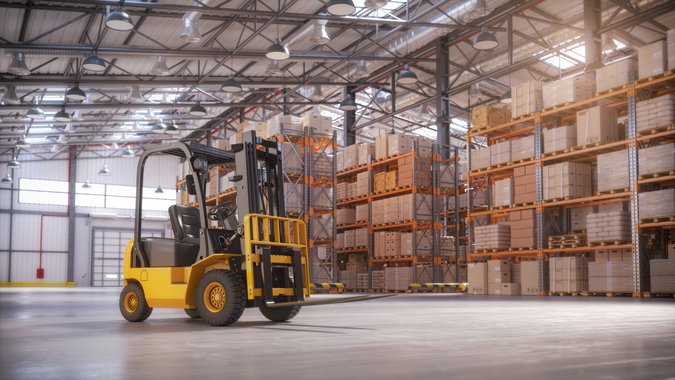
This post describes state licensing structures at a framework level and links to the underlying state sources. It is not legal advice and it is not a compliance opinion. Licensing questions turn on what you actually store and how you actually hold it — read your state’s statute, and if the answer carries real consequences, get counsel who can look at your operation.
The question comes up on the first call, almost every time. Do I need a license to run this warehouse?
The honest answer is one owners rarely believe on first hearing: almost certainly not. Across the forty-eight states we are licensed to place business in, exactly two have a general, merchandise-reaching public-warehouse license — the kind a third-party logistics operator, a contract warehouse, or a fulfillment center would actually fall under. The other forty-six do not license you as a warehouse at all.
And then the second thing happens, which is the reason this post exists. The owner goes and reads their own state’s statute book, finds a law with the words “public warehouse” in the title, and concludes — reasonably, and wrongly — that it is about them.
It is about grain.
The two that are real
Minnesota is the clean case. The Minnesota Warehouse Act — Minn. Stat. ch. 231 — requires a warehouse operator license from the Department of Agriculture for anyone storing goods, wares, records, or merchandise for compensation. That is a general-merchandise reach, deliberately: grain and household goods are handled under separate regimes and are expressly carved out of this one. The license is conditioned on an actual facility inspection covering fire protection, floor capacity, aisle clearance, and pest control, it requires warehouse receipts, and it is tied to the specific city and buildings named in the application.
There is one detail in that statute that stops us every time we read it. The license carries a security requirement, and it can be satisfied by a bond or by proof of warehouse operator’s legal liability insurance. The bailee coverage — the thing this brand exists to place, the policy that answers when a customer’s pallet is destroyed in your building — is named in a state licensing law as the alternative to a bond. No insurance marketing wrote that sentence. A legislature did. If you have ever wondered whether the exposure is real and genuinely distinct from your own property coverage, that is your answer, in a statute. (Minnesota’s specifics live on the Minnesota warehouse page.)
Alabama is the second, and it needs a hedge that we will not skip. Ala. Code § 8-15-1 defines a public warehouse in genuinely general terms — a structure used to store “cotton or other articles of value” for the public — and § 8-15-3 requires a permit to operate one. It sits in the commercial law title, not the agriculture code, and the rules underneath it are specific in a way warehouse operators almost never see: authorized receipts on approved paper, record-keeping, tariff filing, bonding, and an outright duty to insure the goods accepted for storage.
But here is the honest part. In practice, the department’s permitting activity centers on cotton and grain, and the administrative rules are visibly drafted around cotton. So the correct statement — the only correct statement — is that Alabama’s statute on its face reaches more than any neighboring state’s warehouse law does, and that an Alabama contract warehouse should ask the department rather than assume in either direction. We will not tell an Alabama 3PL owner flatly that they need a permit, because that is not established. (See the Alabama warehouse page.)
The grain trap, which is the real subject of this post
Now the part that catches people.
Several states run real, licensed, actively enforced warehouse programs — with bonds, inspections, examinations, and license numbers — whose statutes use exactly the words an owner would search for. And their subject is agricultural commodities.
- Kansas is the worst offender, and it is not close. Kansas genuinely has a statute called the public warehouse law, and it uses the term “public warehouseman” throughout. It obliges a public warehouseman to receive all grain tendered in suitable condition without discrimination, to sample and weigh it, and to file a schedule of storage charges. It is administered by the Department of Agriculture’s grain warehouse program. A fulfillment operation in Edgerton storing consumer goods is not a public warehouseman under it. (Kansas warehouse page.)
- South Dakota licenses “public grain warehousemen” — the phrase is on the Public Utilities Commission’s own bond form. A utilities regulator, licensing grain storage.
- Colorado’s commodity handler program uses the phrase “Public Warehouse” for handlers that store commodities for others.
- Oklahoma charters public grain warehouses under a statute whose name is the public warehouse and commodity indemnity act.
And two more that fail in a different direction:
- New Jersey’s Public Movers and Warehousemen Licensing Act is a household-goods law under Consumer Affairs. It protects a family whose furniture is on a truck. It does not reach your customer’s pallets. Nevada’s warehouse permit is household-goods only as well.
- Vermont issues a literal Public Warehouse License — for storage-for-hire of farm commodities: milk, cream, butter, cheese, eggs, dressed meat, poultry, fruit.
Six states, seven statutes, and every one of them will come back at the top of a search for “public warehouse license [my state].” The title is not the scope. An owner who reads only the title gets the answer wrong, and gets it wrong in both directions — some conclude they are illegally unlicensed and go chasing a permit that does not apply to them; others, in a state with a grain program, assume the state has already defined their duties and stop reading their own storage contract.
That second error is the expensive one.
<rect x="230" y="20" width="240" height="44" rx="9" fill="#ffffff" stroke="#C3DEDE"/>
<text x="350" y="40" text-anchor="middle" font-family="Inter, sans-serif" font-size="13" font-weight="600" fill="#0F4C5C">Does my state license</text>
<text x="350" y="57" text-anchor="middle" font-family="Inter, sans-serif" font-size="13" font-weight="600" fill="#0F4C5C">my warehouse?</text>

<path d="M350 64 L350 84" stroke="#0F4C5C" stroke-width="2" fill="none"/>
<path d="M350 84 L120 84 L120 106" stroke="#0F4C5C" stroke-width="2" fill="none" marker-end="url(#lic-arrow)"/>
<path d="M350 84 L350 106" stroke="#0F4C5C" stroke-width="2" fill="none" marker-end="url(#lic-arrow)"/>
<path d="M350 84 L580 84 L580 106" stroke="#0F4C5C" stroke-width="2" fill="none" marker-end="url(#lic-arrow)"/>

<rect x="24" y="110" width="192" height="150" rx="9" fill="#ffffff" stroke="#C3DEDE"/>
<text x="120" y="132" text-anchor="middle" font-family="Inter, sans-serif" font-size="12" font-weight="600" fill="#0F4C5C">A real general license</text>
<text x="120" y="154" text-anchor="middle" font-family="Inter, sans-serif" font-size="11" fill="#3F5B64">Reaches goods, wares,</text>
<text x="120" y="169" text-anchor="middle" font-family="Inter, sans-serif" font-size="11" fill="#3F5B64">and merchandise</text>
<text x="120" y="191" text-anchor="middle" font-family="Inter, sans-serif" font-size="11" fill="#3F5B64">Inspection, receipts,</text>
<text x="120" y="206" text-anchor="middle" font-family="Inter, sans-serif" font-size="11" fill="#3F5B64">financial security</text>
<text x="120" y="230" text-anchor="middle" font-family="Inter, sans-serif" font-size="11" font-style="italic" fill="#3F5B64">One state lets you meet it</text>
<text x="120" y="245" text-anchor="middle" font-family="Inter, sans-serif" font-size="11" font-style="italic" fill="#3F5B64">with bailee insurance</text>

<rect x="254" y="110" width="192" height="150" rx="9" fill="#ffffff" stroke="#C3DEDE"/>
<text x="350" y="132" text-anchor="middle" font-family="Inter, sans-serif" font-size="12" font-weight="600" fill="#0F4C5C">The trap</text>
<text x="350" y="154" text-anchor="middle" font-family="Inter, sans-serif" font-size="11" fill="#3F5B64">The statute is titled</text>
<text x="350" y="169" text-anchor="middle" font-family="Inter, sans-serif" font-size="11" fill="#3F5B64">“public warehouse”</text>
<text x="350" y="191" text-anchor="middle" font-family="Inter, sans-serif" font-size="11" fill="#3F5B64">Its scope is grain —</text>
<text x="350" y="206" text-anchor="middle" font-family="Inter, sans-serif" font-size="11" fill="#3F5B64">or household goods</text>
<text x="350" y="230" text-anchor="middle" font-family="Inter, sans-serif" font-size="11" font-style="italic" fill="#3F5B64">It does not reach a</text>
<text x="350" y="245" text-anchor="middle" font-family="Inter, sans-serif" font-size="11" font-style="italic" fill="#3F5B64">merchandise warehouse</text>

<rect x="484" y="110" width="192" height="150" rx="9" fill="#ffffff" stroke="#C3DEDE"/>
<text x="580" y="132" text-anchor="middle" font-family="Inter, sans-serif" font-size="12" font-weight="600" fill="#0F4C5C">No general license</text>
<text x="580" y="154" text-anchor="middle" font-family="Inter, sans-serif" font-size="11" fill="#3F5B64">The ordinary case, and</text>
<text x="580" y="169" text-anchor="middle" font-family="Inter, sans-serif" font-size="11" fill="#3F5B64">the great majority</text>
<text x="580" y="191" text-anchor="middle" font-family="Inter, sans-serif" font-size="11" fill="#3F5B64">No state-written floor</text>
<text x="580" y="206" text-anchor="middle" font-family="Inter, sans-serif" font-size="11" fill="#3F5B64">of duties for you</text>
<text x="580" y="230" text-anchor="middle" font-family="Inter, sans-serif" font-size="11" font-style="italic" fill="#3F5B64">The duty of care does</text>
<text x="580" y="245" text-anchor="middle" font-family="Inter, sans-serif" font-size="11" font-style="italic" fill="#3F5B64">not go away with it</text>

<path d="M120 260 L120 284 L350 284" stroke="#0F4C5C" stroke-width="2" fill="none"/>
<path d="M350 260 L350 284" stroke="#0F4C5C" stroke-width="2" fill="none"/>
<path d="M580 260 L580 284 L350 284" stroke="#0F4C5C" stroke-width="2" fill="none"/>
<path d="M350 284 L350 306" stroke="#0F4C5C" stroke-width="2" fill="none" marker-end="url(#lic-arrow)"/>

<rect x="150" y="310" width="400" height="60" rx="9" fill="#C8935A" stroke="#0F4C5C"/>
<text x="350" y="336" text-anchor="middle" font-family="Inter, sans-serif" font-size="14" font-weight="600" fill="#1A1A1A">Where there is no license,</text>
<text x="350" y="358" text-anchor="middle" font-family="Inter, sans-serif" font-size="14" font-weight="600" fill="#1A1A1A">the storage contract is the regulation.</text>

<text x="350" y="396" text-anchor="middle" font-family="Inter, sans-serif" font-size="12" font-style="italic" fill="#3F5B64">Read the scope of the statute, never its title.</text>What the absence of a license actually means
This is the part that is worth more than the licensing trivia, and it is the reason we treat the negative finding as a finding rather than a shrug.
A licensing regime is, functionally, a state-written floor. It tells you what receipts to issue, what records to keep, what the facility has to look like, and what financial security stands behind your promise. Minnesota does that. Alabama’s statute does that on its face.
In a state with no general license, none of that is written for you. And people hear that as freedom. It is not freedom. The duty of care you owe a customer’s goods does not evaporate because no regulator defined it — it simply gets defined somewhere else, by the bailment and the storage contract you signed. A document drafted by whichever party had leverage, enforced by a court rather than a department, and containing — if you were careful, and most operators were not — a limitation of liability that will be the entire argument when something goes wrong.
So the sentence to take away is not “my state doesn’t license me, so there’s nothing to do.” It is: with no license, the storage contract is the regulation. Which means the storage contract deserves the attention you would have given a licensing inspector. We wrote about the mechanics of that document in Warehouse Receipts: What Your Liability Limit Actually Does, and the coverage that sits behind it is warehouse legal liability.
The axis that does catch people, and it is not this one
One clarification, because otherwise this post overstates itself.
Everything above is about a single question: are you licensed as a warehouse, for the act of warehousing? Mostly, no. But what you store can pull you into an entirely different regime, and those regimes are real and enforced — state food-warehouse and cold-storage licensing that attaches to the building; pharmacy-board licensing that reaches a third-party logistics provider handling someone else’s drug product; alcohol wholesaler licensing under a state’s three-tier system; federal customs bonding for a bonded warehouse.
Those are commodity and custody regimes. They stack on top of the licensing answer rather than replacing it — and they are the reason two warehouses on the same street, one holding dry consumer goods and one holding food, can have completely different regulatory files. The per-state detail lives on the state pages; you can find yours from the locations index, and the warehouse insurance program is built around the fact that the answer changes by building, not just by state.
If you want someone to read your storage contract and your state’s actual posture together, rather than one at a time, that is the conversation.
Sources
Every posture above comes from this brand’s own state data layer, whose forty-eight state entries were verified against primary state sources during the build. The specific programs named here trace to these:
- Minnesota Department of Agriculture — general merchandise warehouse licensing (the Minnesota Warehouse Act, Minn. Stat. ch. 231). mda.state.mn.us
- Alabama Department of Agriculture and Industries — gins and warehouses (Ala. Code § 8-15-1, § 8-15-3). agi.alabama.gov
- Kansas — the public warehouse law (Kansas statutes, grain warehouse chapter). ksrevisor.gov
- South Dakota Public Utilities Commission — warehouse licensing (public grain warehousemen). puc.sd.gov
- Colorado Department of Agriculture — commodity handler program. ag.colorado.gov
- Oklahoma Department of Agriculture, Food and Forestry — licensing and permits. ag.ok.gov
- New Jersey Division of Consumer Affairs — Public Movers and Warehousemen (household goods). njconsumeraffairs.gov
- Nevada Revised Statutes — household goods and effects storage. leg.state.nv.us
- Vermont Agency of Agriculture, Food and Markets — Public Warehouse License (farm commodities). agriculture.vermont.gov
Two deliberate absences. First, this post does not enumerate all forty-eight state postures, and that is on purpose — a table would be the wrong shape for a question whose answer turns on what you store and how you hold it. The state pages carry the per-state detail. Second, we state no permitting outcome for Alabama. The statute’s general terms are quotable; whether a given contract warehouse must hold a permit is a question for the department and for counsel, and we will not invent an answer to it.