

Every warehouse owner who asks what insurance costs is really asking a different question underneath: what is it that an underwriter is actually looking at?
The answer is more interesting than a rate card would be, and it starts somewhere counterintuitive. The largest single input into a warehouse premium is not on your balance sheet, does not appear in your accounts, and is not something you own.
The biggest driver is the thing you do not own
Your building is yours. Your racking is yours. You know what they cost, your accountant knows what they cost, and an underwriter can verify both in an afternoon.
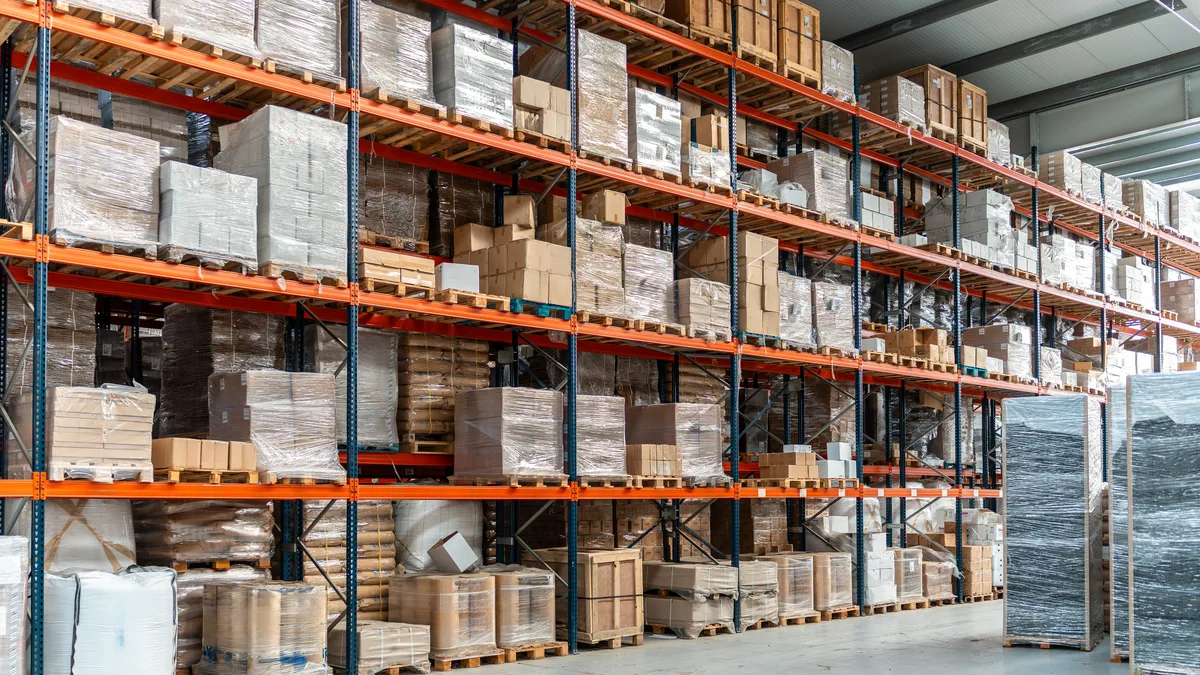
The pallets on that racking belong to your customers. They are frequently worth more than the structure around them, they are the loss you are most likely to have — and they are the number warehouse owners most often understate, precisely because that inventory has never once appeared in their own books.
That is what sizes your warehouse legal liability limit, and it is the first conversation in every honest warehouse quote. Two inputs drive it, and they are separate.
Value is the maximum, not the average. Not what is here on a normal Tuesday — what is the most customer-owned freight that has ever been under this roof at once, on the worst night of your busiest month? A limit set to your comfortable average is a limit that fails you exactly when you need it.
Nature is the input almost everyone skips. A building of paper stock and a building of consumer electronics can be identical square footage, identical rack, identical sprinkler design — and price nothing alike, because the amount at risk in a single pallet position differs by an order of magnitude. Add pharmaceuticals, spirits, or high-theft goods and the theft profile shifts as well as the fire severity.
So the underwriting question is never “how big is your warehouse.” It is: what is in it, whose is it, and what is the most of it that is ever here at once?
The building, the racking, and the fire protection over it
Your own property is the second conversation, not the first — but it is not a small one. Commercial property covers what is yours and stays put: the structure, the racking and material-handling systems, and the business income you lose while the site cannot ship.
What an underwriter weighs:
- Construction, roof, and location. A big-box roof is an enormous, low-profile surface. Wind loads it, hail bruises an entire membrane plane at once, and snow drifts against parapets and roof steps in loads nobody drew.
- Fire protection, and whether the sprinkler design actually matches what you store and how high you stack it. A system designed for one commodity class in a building now full of another is the most common and most expensive gap in this trade.
- Rack height, aisle layout, and storage arrangement — because a rack collapse is a property loss and a bailee loss arriving in the same instant: your steel, and somebody else’s inventory on the floor beneath it.
- Flood and earthquake, which are their own placements and not perils the property form quietly picks up.
Follow every one of those to its end and it lands in the same place: the roof or the pipe or the rack gives way, the water or the debris reaches the goods — and the goods are not yours.
What you hold changes what you pay
Three operating postures move the number in ways square footage never explains.
Bonded and foreign-trade-zone freight. Admit duty-deferred goods and you take on customs obligations on top of your ordinary duty of care to the owner. Over the same pallet you now answer to two masters, and an underwriter prices the accumulation of both. This is not only a seaport story — inland zones hold railed containers before duty is paid, and land-border zones do the same for truck freight.
Cold-chain. Cold-chain bailment fails differently from dry, and this is the loss that teaches the lesson best. The building never burns. The temperature simply drifts, and a customer’s perishable or temperature-sensitive load is a total loss with the racking untouched. There is no property claim to make, because there is no property damage — only an obligation to somebody whose goods were destroyed in your custody. Alarms, redundancy, backup power, and monitoring records are what price it.
Fulfillment. High-velocity, unit-level bailment. Thousands of small customer-owned items moving daily means the loss is rarely one catastrophic event and much more often an accumulation of shrink, mis-ships, and handling damage. That is a frequency story rather than a severity story, and it is underwritten as one.
The storage contract — which, in most of the country, is the regulation
Here is the fact that reframes everything for most owners: in the overwhelming majority of states, no general public-warehouse license exists.
That absence is a cost driver, not a footnote. Because the state hands you no statutory standard of care, your warehouse receipt and storage agreement are the entire perimeter around a claim — and an underwriter reads them before binding. Whether your customers accepted a limitation-of-liability or released-value clause, negotiated it away, or signed a contract that quietly assumes you carry far more than a bare legal-liability form provides, all of that changes the exposure the policy is being asked to size.
Which brings us to the part of this that owners most often get wrong.
How the states actually differ
<text x="350" y="30" text-anchor="middle" font-family="Inter, sans-serif" font-size="15" font-weight="600" fill="#0F4C5C">Who writes your standard of care — the state, or you?</text>

<rect x="24" y="48" width="216" height="150" rx="10" fill="#C8935A" stroke="#0F4C5C"/>
<text x="132" y="74" text-anchor="middle" font-family="Inter, sans-serif" font-size="13" font-weight="600" fill="#1A1A1A">The state licenses you</text>
<text x="132" y="100" text-anchor="middle" font-family="Inter, sans-serif" font-size="11" font-weight="600" fill="#1A1A1A">Two states reach merchandise</text>
<text x="132" y="124" text-anchor="middle" font-family="Inter, sans-serif" font-size="11" font-weight="600" fill="#1A1A1A">Minnesota — the security rule can</text>
<text x="132" y="142" text-anchor="middle" font-family="Inter, sans-serif" font-size="11" font-weight="600" fill="#1A1A1A">be met with the coverage itself</text>
<text x="132" y="166" text-anchor="middle" font-family="Inter, sans-serif" font-size="11" font-weight="600" fill="#1A1A1A">Alabama — general terms, but the</text>
<text x="132" y="184" text-anchor="middle" font-family="Inter, sans-serif" font-size="11" font-weight="600" fill="#1A1A1A">practice runs to cotton and grain</text>

<rect x="248" y="48" width="204" height="150" rx="10" fill="#ffffff" stroke="#C3DEDE"/>
<text x="350" y="74" text-anchor="middle" font-family="Inter, sans-serif" font-size="13" font-weight="600" fill="#0F4C5C">The state licenses the room</text>
<text x="350" y="100" text-anchor="middle" font-family="Inter, sans-serif" font-size="11" fill="#3F5B64">Food and refrigerated warehouses</text>
<text x="350" y="120" text-anchor="middle" font-family="Inter, sans-serif" font-size="11" fill="#3F5B64">licensed as buildings, because of</text>
<text x="350" y="140" text-anchor="middle" font-family="Inter, sans-serif" font-size="11" fill="#3F5B64">what other people keep inside them</text>
<text x="350" y="168" text-anchor="middle" font-family="Inter, sans-serif" font-size="11" fill="#3F5B64">A compliance layer a dry-goods</text>
<text x="350" y="186" text-anchor="middle" font-family="Inter, sans-serif" font-size="11" fill="#3F5B64">warehouse does not carry</text>

<rect x="460" y="48" width="216" height="150" rx="10" fill="#ffffff" stroke="#C3DEDE"/>
<text x="568" y="74" text-anchor="middle" font-family="Inter, sans-serif" font-size="13" font-weight="600" fill="#0F4C5C">The state licenses nothing</text>
<text x="568" y="100" text-anchor="middle" font-family="Inter, sans-serif" font-size="11" fill="#3F5B64">The ordinary case, and most of</text>
<text x="568" y="118" text-anchor="middle" font-family="Inter, sans-serif" font-size="11" fill="#3F5B64">the country sits here</text>
<text x="568" y="144" text-anchor="middle" font-family="Inter, sans-serif" font-size="11" fill="#3F5B64">Your warehouse receipt and your</text>
<text x="568" y="162" text-anchor="middle" font-family="Inter, sans-serif" font-size="11" fill="#3F5B64">storage agreement are the whole</text>
<text x="568" y="180" text-anchor="middle" font-family="Inter, sans-serif" font-size="11" fill="#3F5B64">standard of care you have</text>

<rect x="24" y="216" width="652" height="88" rx="10" fill="#ffffff" stroke="#0F4C5C"/>
<text x="350" y="242" text-anchor="middle" font-family="Inter, sans-serif" font-size="13" font-weight="600" fill="#0F4C5C">The trap: read the scope, never the title</text>
<text x="350" y="266" text-anchor="middle" font-family="Inter, sans-serif" font-size="12" fill="#3F5B64">Several states run grain programs whose statutes are named public warehouse laws.</text>
<text x="350" y="288" text-anchor="middle" font-family="Inter, sans-serif" font-size="12" fill="#3F5B64">Others use the phrase for household goods. Neither one will price your building.</text>

<text x="350" y="340" text-anchor="middle" font-family="Inter, sans-serif" font-size="12" fill="#3F5B64">Where the state supplies no rule, the contract supplies all of it —</text>
<text x="350" y="360" text-anchor="middle" font-family="Inter, sans-serif" font-size="12" fill="#3F5B64">and the contract is the document an underwriter actually reads.</text>
<text x="350" y="388" text-anchor="middle" font-family="Inter, sans-serif" font-size="12" font-style="italic" fill="#3F5B64">No band on this diagram is a price. All of them shape one.</text>
The public-warehouse statute spectrum
Exactly two states have a warehouse license that reaches general merchandise.
Minnesota is the remarkable one. Its Warehouse Act requires anyone storing goods, wares, records, or merchandise for compensation to be licensed — and the security requirement attached to that license can be satisfied by proof of warehouse operator’s legal liability insurance. The coverage this entire trade is built around is named in a state licensing statute. In Minnesota, the state effectively tells you to buy the line. The Minnesota cost guide walks the whole regime.
Alabama has a public-warehouse statute drafted in general terms, requiring a permit and carrying an outright insurance requirement on the goods accepted for storage. And the caveat belongs in the same breath: the department’s permitting practice centers on cotton and grain, and the rules are visibly written around cotton. It would be wrong to tell an Alabama third-party operator flatly that they need a permit, and equally wrong to say the state licenses nothing. The Alabama cost guide holds both facts at once, which is the only honest way to hold them.
Everywhere else, the storage contract is the regulation. Not a lesser version of a license — the whole of it.
The grain trap, named plainly
Several states run real, serious licensed warehouse programs whose names say public warehouse — and they are grain laws. Kansas has a public warehouse law with public warehousemen in it. South Dakota licenses public grain warehousemen. Colorado’s commodity program uses the phrase. Oklahoma has a Public Warehouse and Commodity Indemnity Act.
An owner who opens their own state’s statute book, reads the title, and concludes that their fulfillment building is regulated has made an expensive mistake in the wrong direction — and one who concludes the opposite, that a grain license is all the state does and therefore nothing else matters, has made it in the other. The Kansas cost guide exists partly to say this out loud.
Two more in the same family: New Jersey’s public movers and warehousemen statute is a household-goods law, and Nevada’s warehouse permit is household-goods only. Vermont issues something literally called a Public Warehouse License, scoped to storage-for-hire of farm commodities.
Read the scope. Never the title.
The states that license the room
There is a third posture, and it is a genuine compliance-cost layer a dry-goods warehouse simply does not carry: several states license the food or refrigerated warehouse as a building.
New York’s refrigerated warehouse and locker plant license is written expressly for a facility renting cold space to hold food owned by other businesses — a bailee license in all but name. Massachusetts licenses cold storage outright. Washington licenses the food storage warehouse as its own class, so a processor storing finished product offsite must put it in a licensed food-storage building. Connecticut issues a Food Warehouse license.
The pattern is worth naming, because it says something true: these states have looked at the cold-storage bailee and decided the room is what needs regulating. If you are that operator, you carry a compliance cost, an inspection regime, and an underwriting story that the dry warehouse across the street does not.
Bonded and FTZ: answering to two masters
Customs obligations do not replace the duty of care you owe the owner of the goods. They stack on top of it. Over the same pallet, at the same moment, you answer to two masters — and an underwriter prices the accumulation. That is true at a seaport, at a land border, and at an inland rail terminal where a container sits in zone status before duty is paid.
Your crew, and a comp posture that is not the same everywhere
Workers compensation scales with material-handling payroll, and the classifications you actually run matter as much as the figure. The claim set is remarkably consistent across the country: powered-industrial-truck strikes, falls from racking and order pickers, dock and trailer injuries, material coming down off elevated storage, and lifting and repetitive-reach strain on a pick line.
What is not consistent is how you buy it.
Four states run the statutory line through a state fund — North Dakota, Ohio, Washington, and Wyoming. In those states private workers-compensation insurance is not sold for the statutory line at all: an employer holds a state account or qualifies as a self-insured employer. You cannot shop it, which means loss control and your claims record with the state carry more weight, not less, and the private program is built around everything else. See the Washington cost guide for what that looks like in a state with a heavy warehouse economy.
Texas is the other exception, in the opposite direction. Comp is generally elective there for private employers, so a warehouse can legally opt out and become a non-subscriber — forfeiting the common-law defenses comp otherwise provides, on a floor where forklift strikes and racking falls are the routine claims. Outside the comp system those stop being no-fault claims and become negligence lawsuits. The Texas cost guide treats that decision as what it is: part of an accurate quote, not a surcharge.
Everywhere else, it is an ordinary private-market line — including the large warehouse economies of California and Pennsylvania, where the exposure is enormous and the market is competitive.
Claims, limits, and the retention you choose
Claims history moves pricing more than almost anything else on this page — and not merely whether you have had losses. Several small handling-damage claims tell an underwriter something quite different about how a building runs than one large one does.
Limits and retention are a genuine choice, and the honest framing is this: you are deciding how much of the small stuff you want to fund yourself in exchange for a better price on the part you cannot afford. A warehouse that comfortably absorbs routine handling damage and buys a serious warehouse legal liability limit for the fire is buying its insurance in the right order.
The honest summary
A warehouse is priced on custody, not on square footage. The building matters, the crew matters, the perils matter — but the number that moves the premium most is the freight belonging to somebody else that is sitting on your racking tonight, and the contract you signed about what happens if it burns.
Two states will hand you a standard of care. A handful more will license your cold room. In the rest of the country, you wrote your own standard of care the day you signed a storage agreement, and an underwriter is going to read it.
If you want the coverage itself rather than the cost, start with warehouse legal liability — the bailee line this whole conversation is really about — or see how we build a program for warehouse businesses. When you are ready, request a quote and we will rate your real operation rather than post a guess.